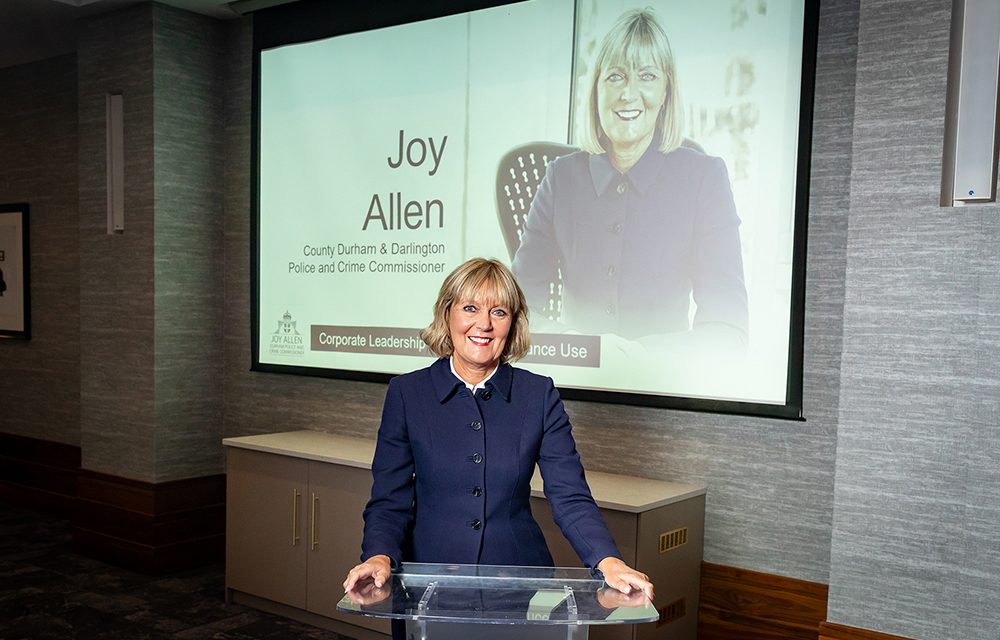
Police and Crime Commissioner Joy Allen has welcomed the launch of a new national Road Safety Strategy setting out unprecedented action to save lives on the UK’s roads – but challenged the Government to do even more.
The blueprint, unveiled recently, is built around an ambition to reduce deaths and serious injuries on Britain’s roads by 65% by 2035 – and 70% for children under 16 – through a series of new safety measures that have long been championed by the County Durham and Darlington PCC and have helped to shape the new national approach.
The ardent road safety campaigner, who is Joint National Lead for Roads Policing on behalf of the Association of Police and Crime Commissioners (APCC), has lobbied tirelessly alongside bereaved families and campaigners to prevent more unnecessary deaths and injuries on the roads, securing wide cross-sector support through her efforts.
Her work has included robust support for the ‘Life is Precious’ campaign raising awareness of the fatal four driving offences (speeding, mobile phone use, no seatbelts and drink or drug driving).
The PCC has previously set out a series of commitments in her Police, Crime and Justice Plan to secure practical and evidence-based changes that will save lives and increase public confidence on the roads and has campaigned nationally for other reforms to eliminate risk.
These include:
• Lowering the drink-drive limit to align with Scotland and Europe.
• Immediate licence suspension for those arrested and charged with drink and drug driving offences until they attend court.
• Stronger drug-driving enforcement, especially for cannabis and cocaine, and a faster forensic turnaround of testing – with full cost recovery.
• Mandatory National Driver Offender Retraining (NDOR) to re educate and retrain drink/drug drivers and other dangerous motorists.
• Fit-to-drive reforms, including mandatory eye tests for those who have prescription lenses linked to insurance and licence renewal.
• Local reinvestment of motoring fines and offender costs into road safety.
• Maximising new technological opportunities to prevent harm to all road users and the development of advanced analytical capability to support policing the roads.
She has also provided full backing to families from Forget-me-not Families Uniting (FFU) who are campaigning for urgent measures including Progressive Driving Licences (GDL) for newly qualified drivers to slash the high number of young driver deaths in the UK.
They include Karen and John Rowlands, from Durham, whose son Andew was a passenger in a car that had been bought by a friend for £100 and was illegal and unroadworthy when it crashed in June 2020, claiming his life.
In launching the Road Safety Strategy, the Government has announced new consultations covering the introduction of a three or six-month minimum learning period to give learner drivers more time to develop their skills, the lowering of the drink drive limit in England and Wales which has remained unchanged since 1967, and mandatory eyesight testing for those over 70.
It has also pledged to explore the use of preventative technology, such as alcohol interlock devices, as a condition for being allowed to drive again following prosecution, new powers to suspend driving licences for those suspected of drink or drug driving offences and the launch of a new Road Safety Investigation Branch to analyse collision patterns, drawing on police and healthcare data to inform prevention strategies.