Ref: ‘Detailed Plans for Gold Standard High Temperature Waste Treatment Plant” Newton News – 15th August 2025’.
Firstly, it was almost a relief to see the CEO of Fornax had some input into local information, to give the residents an opportunity to see what is awaiting approval from the Environment Agency.
On the face of it, the incinerator looks to be state of the art, according to all the descriptions set out in the plans, however there are several anomalies which means the incinerator is maybe not quite as gold standard as it could be and this raises several important questions, some of which are listed below.
The statement that the incinerator will generate enough energy to power 700 homes is probably correct, however, how will this ‘power’ be distributed? The ‘power’ the plant is producing is heat – not electricity, therefore, what looks good on paper, is not likely to become actual for any local homes.
The statement that the plant has been designed with the best available proven techniques from Europe, however, there is no Flue Gas recirculation, which further reduces NOx – nor is there any Carbon Gas capture – see the Olive report on operating techniques – both technologies are available and beneficial, therefore why are they not implemented?
There are two different air dispersion modelling reports. The first, produced by Independent Air Quality & Odour Specialists, dated May 2022 uses the meteorological data from Teesside Airport. This data has the prevailing wind direction for Newton Aycliffe, as predominantly south westerly. In the second report, produced by Olive Consulting, dated February 2024, the prevailing wind direction is taken from the meteorological data from RAF Leeming, which is much further away from Newton Aycliffe and the prevailing wind direction used in this report is south easterly.
Why are there two reports, (both sent to DCC planning) and why is the second one in the EA permit application, using the air dispersion modelling data which is the furthest away from Newton Aycliffe?
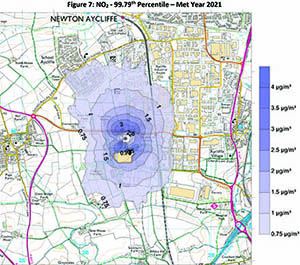
All documents referenced above are available on DCC planning portal. Reference Docs FYI. Included are the diagrams from the air dispersion documents for reference: Left is the first report, right is the Olive report:
These show the air dispersion for NOx, the scale of the maps are very close, however, the spread of the NOx is much higher concentration in the first than in the second.
We really want Fornax to explain why they are using the Olive report.
Name and address supplied.