Responses to questions from a Newton News reader about the facility in Newton Aycliffe
Answers from Ian Jones, CEO of Fornax Environmental Solutions
Question 1
There seems to be a very concerning lull in the responses by Fornax, local council and our MP to the worries and issues raised by residents over the past months, regarding the decision to build the hazardous waste incinerator in Newton Aycliffe so close to residents and businesses.
Answer 1
In recent months, Fornax has gone to great lengths to engage with the local community about its plans for the development of a new facility in Newton Aycliffe. We have invited local councillors, MPs, business leaders and others to visit our facility and will continue to do so. Most people who have been invited or have requested a site visit have been.
We have also invited the media to site, issued press releases, taken part in a Q&A radio interview with concerned councillors on Aycliffe Radio, and circulated an information leaflet to 5,000 homes and businesses in the areas closest to the site. Alongside this, we have established a comprehensive website – www.fornax.co.uk – explaining the development, technology, and environmental considerations.
During the past eight months, in particular, there have been a number of visits by local groups and elected members, including Durham County Council senior officers and councillors, including the Council Leader, members of Aycliffe Town Council, Heighington Parish Council, a local MP, local councillors, and other interested parties, including local businesses. Only last week, we welcomed visitors to site.
We have also attended breakfast meetings organised by Aycliffe Business Park and have spoken with a number of local business representatives. We’ve also been in email communication with several people who have written to us.
We are eager to build a trusting, two-way relationship with the local community and are very happy to answer questions and share our plans for the site. Currently, we are busy completing the plant (Scheduled for Q4 2026) and are awaiting a decision from the Environment Agency on our permit application., in the meantime, if anyone would like to know more about the facility, there is a lot of information at www.fornax.co.uk People can also email on info@fornax.co.uk
Subject to us being granted a permit to operate by the Environment Agency, we will also be establishing a Community Liaison Group, which will be independently chaired. It will be an important vehicle for us to build a trusting relationship with the community, listen to feedback, establish shared goals, and contribute social value to the area.
Question 2
Back in September 2025, this letter was published in the Newton News and to date, we have not seen any answers to the questions highlighted below. Therefore, we invite the CEO
of Fornax to answer the questions raised as it was the Fornax letter to the Newton News which raised the questions in the first place.
On the face of it, the incinerator looks to be state of the art according to all the descriptions set out in the plans, however there are several anomalies which means the Incinerator is maybe not quite as Gold standard as it could be and this raises several important questions, some of which are listed below.
The statement that the Incinerator will generate enough energy to power 700 homes is probably correct, however, how will this “power” be distributed? The “power” the plant is producing is heat – not electricity, therefore what looks good on paper, is not likely to become actual for any local homes.
Answer 2
In real terms, the power generated is up to 6MW/hr. This number tends to be fairly meaningless for many people, so it is standard industry practice in for planning and permit submissions to talk publicly about heat or energy offtake in terms of “numbers of typical houses” that the heat or power could supply. This does not mean the heat will specifically go to homes, but it means heat or energy to that equivalent will be generated for use in the area or supplied to the National Grid.
Homes are not consistent offtakers of hot water throughout a standard UK year, and demand is generally much higher for only four months of the year. The plant, however, generates heat 365 days a year, so feeding heat or steam to nearby industrial processes (businesses) is preferred.
Fornax has already laid the district heat pipes around the site with T-spurs for future use. Offtake agreements for the power are commercially sensitive and confidential, but before anything can be finalised and put in place, Fornax has to demonstrate stable proven operations to show the heat can be supplied at consistent temperatures and used at commercially beneficial rates.
In Europe, when new housing estates are built they generally look to include some “green energy solution” for heat in the scheme. There are recent examples of High Temperature Incineration (HTI) being used in this capacity in the Nordics. However, current public perception of HTI in the UK prevents this from being a reality.
However, we have a number of businesses interested in taking the heat from the Fornax plant, which we are progressing, so the heat we generate will help businesses in Newton Aycliffe to reduce their carbon footprint.
Question 3
The statement that the plant has been designed with the best available proven techniques from Europe, however, there is no Flue Gas recirculation, which further reduces NOx- nor is there any Carbon Gas capture – see the Olive report on operating techniques – both technologies are available and beneficial, therefore why are they not being implemented ?
Answer 3
There is technical misconception and misunderstanding regarding flue gas recirculation, and there are examples of European HTI facilities that have attempted this in the past and failed.
Flue Gas Conditioning (FGC) is an appropriate technology if the fuel or waste being used is of a permanently consistent and guaranteed calorific value (CV) eg: biomass and hazardous waste wood or if it’s a liquid-fed facility, with a blended and stable CV infeed.
Fornax is not a liquid waste facility, nor is it taking stable CV materials. In this scenario, the FGC system would actually be much more harmful from an emissions perspective as it would severely disrupt the thermal temperature profiles required to ensure the elimination of harmful particulates. The crucial aspect of an HTI plant is that it remains at a constantly high temperature of between 850C and 1200C in order to obliterate the most harmful substances.
Also, the constant disruption of kiln temperatures would render the use of the abatement chemicals to control Nox Gas (Ammonia or Urea) ineffective.
The abatement and emissions control solution selected by Fornax is proven Best Available Technology. There were too many examples of FGC failing to control emissions in packaged and solid waste HTI facilities for it to be considered a viable and effective technology.
The updated NOx emissions limits for new plants are 120mg/Nm3, which is a significant reduction from previous limits that were 200mg/Nm3. FGC technology would not help us achieve these new limits and would, in effect, prevent it from being possible. The technology we have chosen will enable us to comfortably meet these new, lower emission limits.
Carbon Capture (CC) is a different topic entirely. Fornax did a multi-technology assessment of the various potential CC systems available today and the effectiveness of them. Firstly, there isn’t a working technology currently implemented on a small HTI plant, like this one, anywhere that we could use as a reliable reference.
Secondly, we identified only two potential non-proven technologies that might work in the future. However, there is currently nowhere to put the captured carbon. Plants that currently operate small scale demonstrator CC models are having to capture the carbon then vent it to air – thereby demonstrating their ability to capture, but not to store the carbon.
The HiNet storage areas identified around the UK are not yet built. The one in Liverpool Bay is the closest to being ready, but the others are many years away. If we wanted to convert the captured carbon to liquid and have it trucked away, it would result in significant additional traffic to site, which a) we are restricted from doing under current planning conditions, and b) which would negate the benefit of having captured the carbon in the first place.
Fornax is continuing to explore future options as CC technology and storage improves, so we have the ability to implement it (subject to planning) when both are available in the future.
Question 4
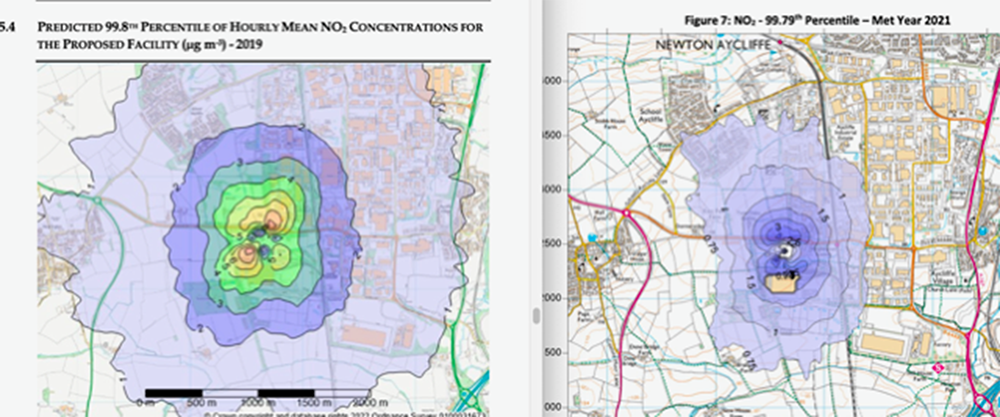
There are two different air dispersion modelling reports. The first, produced by Independent Air Quality & Odour Specialists, dated May 2022 uses the meteorological data from Teesside Airport. This data has the prevailing wind direction for Newton Aycliffe, as predominantly South Westerly. In the second report, produced by Olive Consulting, dated Feb 2024, the prevailing wind direction is taken from the meteorological data from RAF Leeming, which is much further away from Newton Aycliffe and the prevailing wind direction used in this report is South Easterly.
Why are there two reports? (both sent to DCC planning) and why is the second one in the EA permit application, using the air dispersion modelling data which is the furthest away from Newton Aycliffe?
All documents referenced above are available on DCC planning portal
Reference Docs
Included are the diagrams from the air dispersion documents for reference (not necessary to publish)
Left is the First report – Right is the Olive report
Answer 4
Planning and permitting are two different processes that require different approaches. Having an additional Air Quality Assessment (AQA) carried out during the permitting stage by a different competent authority allows significant validation and should give assurances to readers that we have taken a thorough and professional approach to the development of the plant.
It is also worth pointing out that Durham County Council paid for an additional peer review of the AQA by AECOM, which is a global expert in modelling emissions. AECOM concluded that it was satisfied with the approach we had taken and the results of our assessments.
There are two weather stations that could be used for the Newton Aycliffe location and we were advised which one to use by the Environment Agency at the time of application. It is not a decision taken by the applicant or their modelling team. This can be for a variety of reasons, but usually it is simply due to the availability of operational data. It’s important to note, however, that the results from both of our AQA studies, using data from the weather stations at both Teesside Airport and RAF Leeming, gave the same results.
It should also be noted that the assessments were modelled (taking into account background accumulation) on the location where maximum ground level concentration of pollutants were calculated to be. Both studies concluded that predicted maximum ground level concentrations were well within the long-term and short-term air quality objectives and were assessed as “negligible” and “not significant”.
For pollutants with potentially significant impacts, further screening demonstrated that it was unlikely that any air quality standards would be exceeded as a result of emissions – again with studies modelled on the location of maximum point of ground level concentration.
Consequently, if the ground level concentrations fall well below acceptable levels at the point of maximum impact, then they will fall well below acceptable levels at all other points, regardless of whether the specific grid co-ordinates have been considered in the model.
Both AQA assessments were carried out by leading UK specialists and it has been independently verified by AECOM that both followed the Environment Agency guidelines, in accordance with UK and EU legislation.
In addition, Fornax has installed two air quality monitoring devices, with weather stations, to the north and south of our plant, on the site boundaries, which are measuring local wind direction, speed and humidity. These air quality monitors are also capturing and recording Nox and PM10 readings locally, so we have a baseline against which to benchmark future emissions data.
These devices can be used in future to record the level of emissions after the plant becomes operational, which we expect will further validate the air quality modelling. Fornax has offered to share this data with local relevant authorities, including Aycliffe Town Coucil and Heighington Parish Council, as well as the Environment Agency. We do not expect operations at the plant to alter the readings on the monitors above very negligible levels.
The height of the stack
There has been some speculation about the stack height, with people speculating that it is not tall enough. (Following a guidance comment made by the EA at the initial planning stage) However this is not the case as all subsequent engineering reviews have established it complies with BAT and discharged those concerns. We would not have received planning permission or even had our permit application accepted by the Environment Agency if the stack height was incorrect. Both AQA assessment documents looked at “downwash effects” on a building height of 14.8m with a canopy level of 16.7m and concluded that neither would impact dispersion.
The stack height on the Fornax plant has been incorrectly compared to much bigger EfW plants that are incinerating between 200,000 and 400,000 tonnes per annum, with a much greater volume of flue gas generated. Our facility is much smaller – with a maximum capacity of 10,500 tonnes. Durham County Council recently discharged the planning condition regarding the stack height as it fully complied with requirements.
Publicly available information submitted at the time of planning shows the “knee drop” calculations required to determine the optimum stack height to minimise impact of any emissions. This was verified by AECOM (who were appointed by DCC) as being correct.
The stack height screening analysis was undertaken on heights 20m to 38m at 3m intervals. The report was prepared by Dr Amanda Gair BSc PhD MIAQM, MIEnvSc, CEnv, who has over 30 years’ experience specialising in air quality and human health assessments, and is considered one of the most recognised experts in her field.
Her report included a constant effectiveness analysis to define Best Available Technology using Environment Agency guidance. It concluded that a stack height of between 26m – 29m would be within safe limits to ensure any pollutants were sufficiently diluted and dispersed before reaching the ground. As our supplier provides stacks in different heights in multiples of five, we adopted a 30m stack. The AQA submitted for both the planning and permit applications used the same input parameters as the stack height screening assessment.