
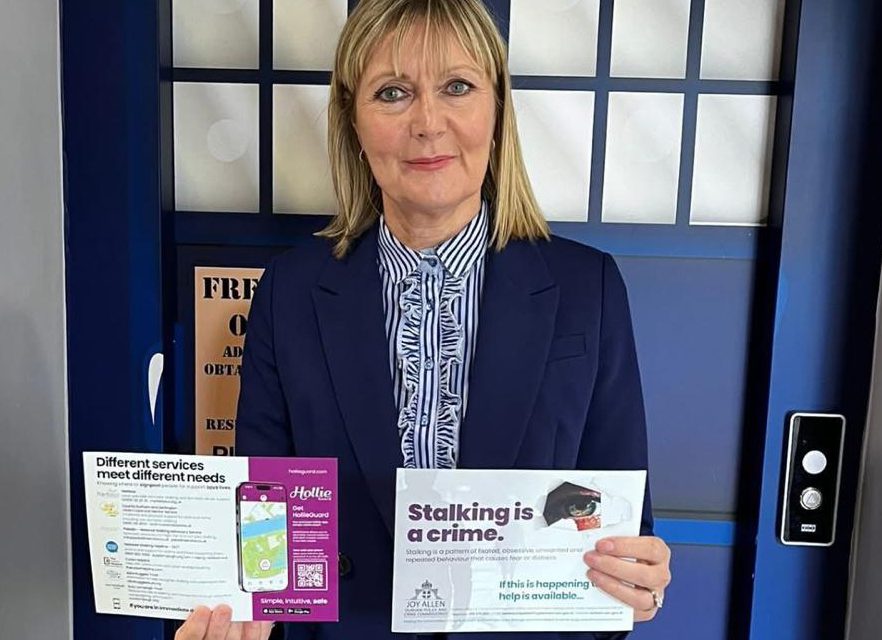
Police and Crime Commissioner Joy Allen has secured more than £370k from the Government to strengthen the prevention of stalking to improve victim safety.
The funding, worth £374,936, will support the delivery of the pioneering Early Awareness Stalking Intervention (EASI) programme over the next 30 months.
The nationally recognised programme takes a public health approach to offending and is aimed at identifying early-stage stalking behaviours before they escalate and cause severe psychological harm or result in physical violence
It will support adults in County Durham and Darlington who commit a first, lower-risk stalking offence and accept responsibility for their behaviour.
Over six sessions, a specialist clinical or forensic psychologist will use tested approaches to address fixation, obsession, emotional regulation and other drivers of stalking.
The aim is to reduce unwanted contact, harassment, monitoring, surveillance and repeat offending, while increasing accountability, insight and victim safety.
Delivered by the County Durham and Darlington Stalking Intervention Partnership (D-SIP) – a multi-agency collaboration between the Commissioner’s office, Durham Constabulary, North-East Probation Service, Tees, Esk and Wear Valleys NHS Foundation Trust, victim care services and members of the National Stalking Consortium including Alice Ruggles Trust and Paladin, the National Stalking Advocacy Service, it is part of well-established domestic abuse prevention approaches to encourage perpetrators to disengage from stalking, address their fixation and lower reoffending rates.
Eligible cases will be identified through daily police screening and may enter the programme through a Stalking Prevention Order or as a part of a conditional caution or post-conviction license condition.
Higher-risk cases will remain within established safeguarding and criminal justice arrangements.
A multi-agency DSIP panel will coordinate safeguarding, risk management and wider support.
The PCC and victims’ campaigner prioritises a prevention-first approach in her Police, Crime and Justice Plan, backing her ambitions with significant investment in tackling the drivers of offending to prevent relapse, reduce future victims and build stronger and safer communities.
Victims are front and centre of the PCC’s safety work, and the first of six priorities in her Police, Crime and Justice Plan. She has campaigned tirelessly locally and nationally to ensure the criminal justice system is seen through the eyes of victims, pledging to deliver a first-class service that delivers faster justice, higher-quality care and support, and improved contact with police to build trust and confidence.
The PCC has already provided specialist training for some key support workers within her Victim Care and Mentor Service (VCAMS) to become Independent Stalking Advocacy Caseworkers.
Police and Crime Commissioner Joy Allen said: “Stalking has a debilitating and profound emotional impact on victims and is treated very seriously in Durham.
“We must do everything in our power to protect future victims from these appalling crimes but this can’t be achieved with punitive measures alone; we must tackle the source of the offending and work directly with offenders to achieve lasting behavioural change to reduce the risk they pose to future victims and our communities.
“This is not about replacing enforcement. Perpetrators must be relentlessly pursued and held accountable for their crimes. It is about making our criminal justice sanctions more meaningful and working more holistically to achieve better outcomes in the long-term and ultimately saving and protecting lives.”
Victims of stalking often experience more than 100 incidents before reporting them to the police, accumulating months or years of psychological harm.
Around one in every five women in the UK and one in 10 men will experience stalking in their lifetimes.
The Crime and Policing Act 2026 introduced several new and expanded measures to tackle stalking. Courts are now allowed to impose Stalking Protection Orders (SPOs) directly upon the conviction or acquittal of a defendant without a prior police application. In addition, new guidance empowers police to release the identity of anonymous or online stalkers to victims at the earliest opportunity for safeguarding purposes.
Locally, the PCC has jointly funded training for frontline and investigative officers to understand the difference between stalking and harassment, enhance their risk assessment processes and the application of policing powers.
She has also funded assembly talks in association with the Alice Ruggles Trust in more than 50 schools across the force area to raise awareness of the early signs of stalking behaviour to prevent future tragedies.